
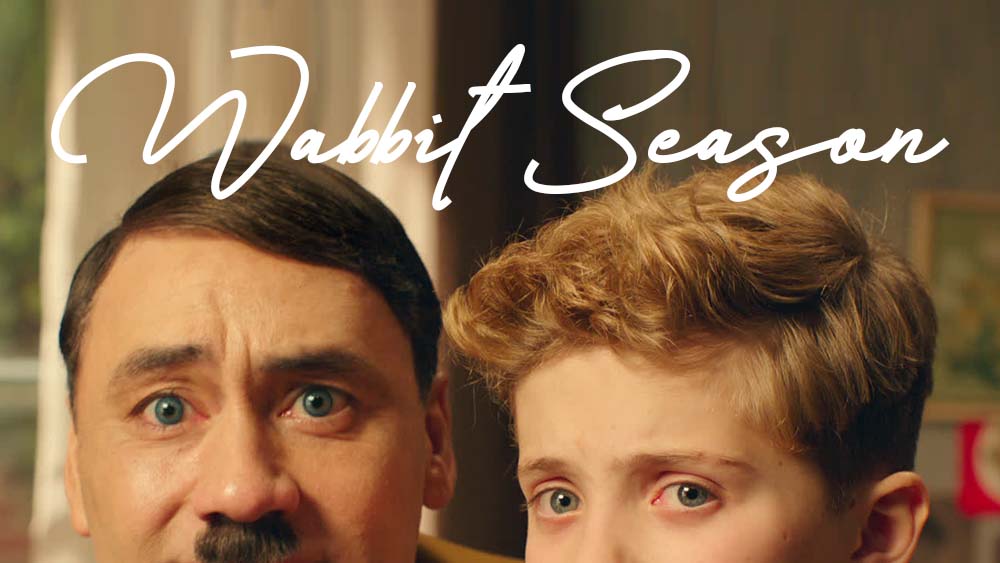
Easter is upon us, and I have randomly decided to take this opportunity to finally experience some of cinema’s famous rabbits, Roger and Harvey. It's wabbit season. Jojo Rabbit's here too.
Imaginary friends
Jojo Rabbit is a warm and poignant comedy about a 10-year-old boy in the Hitler Youth with an imaginary friend, Adolf Hitler himself, and the incredible thing about it is that it somehow works. Props to director Taika Waititi and to Roman Griffin Davis, whose performance as the German boy was stupendous.
Harvey has a sweet message, but I quickly grow impatient with farce. It’s not believable when people constantly misunderstand each other. It would be fine if it was funny. It isn't. I also have difficulty with hysterical, breathless whingeing which seems to be the only direction given to Josephine Hull. I can’t imagine the size of tranquilizer she needed each night after performing.
Race and community
In the Heat of the Night is an incredible crime/mystery/thriller starring Sidney Poitier, who had that rare power to command attention on screen whether moving or unmoving, speaking or mute. He and Rod Steiger make a meal out of every scene they share. This film is based on a novel, and it’s very plotty, laced with ironic turnabouts. Very entertaining.
Do the Right Thing is a 1989 film by Spike Lee about a community with strained racial tensions. It’s a tour de force, offering weighty themes to ponder while feasting on a smorgasbord of vivid colors, dynamic camera movements, and pleasing compositions. Its characters are varied and memorable and it features clever use of symbols. Decades later, the awful thing is how relevant it remains.
The media
Network is an astonishing 1976 film by Sidney Lumet, which I think speaks volumes about capitalism and television, but also, 50 years later, bingos social media and AI. In the same way that the text of the film has a psychotic man proclaiming the repressed feelings of a society, the film itself descends into a kind of madness where the worth of a man’s life is how much attention he can attract; how much money he’s worth. The truth value of our statements doesn’t figure into the calculation. The individual is redundant. In other words, we’re able to recognize our own world as insane. If I’m not mistaken—and believe me, that’s always a real possibility—this is one of those works of staggering genius we hear so much about.
Broadcast News similarly deals with declining media standards, but does so in romcom format. It’s clever and genuinely funny. I wish I discovered it years ago, and that this was my fifth watch instead of my first.
Favorites, revisited
A Serious Man, by the Coen brothers, asks the question underneath every question, “what is going on?” It is one of my all-time favorite movies.
Interstellar brilliantly connects fascinating ideas with awe-inspiring visuals and heart. And all of this is set to an epic and affecting Hans Zimmer score. When I watch this movie so many of my faculties are engaged and in dialogue. It’s exhilarating.
Bob Hoskins
The Long Good Friday is a UK crime film starring Bob Hoskins. The movie is self-serious, but Hoskins delivers a cartoonish performance as a mouth-frothing mob boss. It didn’t work for me.
Who Framed Roger Rabbit, directed by Robert Zemeckis, is a brilliant technical achievement, blending live footage and animation. The filmmakers ingeniously orchestrated in-camera effects so that the toons seem to interact with the real world. It impresses even today.
It’s also a neo noir commenting on corruption in the Hollywood system and Los Angeles city planning. It features sex and alcoholism, and references to bygone pop culture. All of that is in stark contrast with the frenetic slapstick of the cartoon characters. You’d have to be an adult to understand much of what the film is doing, but as an adult, I find the over-the-top zaniness of the animated characters exhausting.
Fascinatingly, Bob Hoskins playing the straight man to the harebrained Roger Rabbit works perfectly.
Now playing
Mother Mary is a film that gradually unspools the fabric of relationship between two people. It is gorgeously staged and colored, with strong performances, and evocative music and dance. It's a ghost story fashion phantasmagoria.
The Drama asks an interesting central question but feels false in a way that overpowers the exploration of it. It intended me to cringe at the characters and situations, which I did, but I cringed more at the film itself and decent performances from good actors couldn't sell it to me.
Ernst Lubitsch
Cluny Brown is a 1946 comedy by Ernst Lubitsch with the good sense to make fun of the self-righteous and to champion individual determinism. Strong characters, and memorable dialogue punctuate this delightful comedy.
Trouble in Paradise is a fun 1932 comedy/romance/crime movie by Lubitsch. I can see getting twelve movies deep into his oeuvre and still thinking "Yep, another good one."
Misc
Through a Glass Darkly is a 1961 Ingmar Bergman film. This one resonated with me, artistic, philosophical, and as inwardly inspecting as it is cosmologically searching. Of course, the other films I've seen by him are this way too. I must explore him further.
Babylon is doing a lot. And I found a lot to appreciate about it. The excess of the film itself is a reflection of the excess in the world it depicts. Cool idea, but it's a hard, hard watch for me. The bleakness and debauchery, the tragic misguidedness of everyone. I fear that the world really is that way, and I do not enjoy beholding it.
Spoiler for Babylon's theme: the movie business is evil but movies are divine. The final words of the script are the best description for what the film is, and what it says about the dichotomy between Hollywood and its movies: "some strange alchemy -- of heartbreak, joy, regret, pride -- and sheer incredulity at the madness of it all".
The Girl Who Leapt Through Time is a cozy film I watched with my kids. Slice of life meets sci-fi. It’s beautifully drawn and its characters are interesting.
John Wick: Chapter 4 is a profoundly stupid movie with cool lighting and stylized combat.
Graphic novels
Sexcastle by Kyle Stark is hilariously self-aware ultra-violent action comic about an assassin who's trying to leave his profession behind him. What makes this so much better to me than John Wick is that Sexcastle knows it's ridiculous, and gives us permission to enjoy its absurd conceit whereas John Wick is self-serious, and we laugh at it instead of with it.