What is this place?
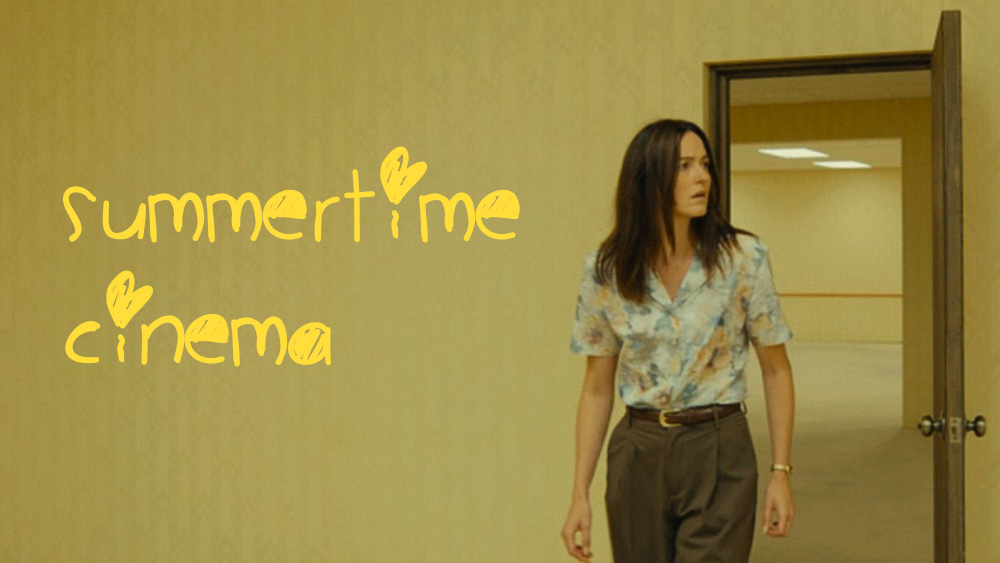
Backrooms is the feature film debut of 20-year-old Kane Parsons, based on his web series of the same name. It explores the horror of eerie "liminal spaces". The film had a strange effect on me; afterwards my mind was still interrogating what I was seeing, judging whether or not there was anything disturbingly off, and whether there was any meaning. My garage, my living room, my Mac's messy desktop. It was an encounter with the Absurd. I think a film that can alter your consciousness is a rare and impressive feat. It reminded me of Cube, which I love.
I showed Cube to my kid and it sparked a lot of conversation.
Andrei Tarkovsky
Andrei Rublev is an expansive film by Andrei Tarkovsky about a 15th-century Russian painter of Orthodox icons. I knew it would be a long film—Tarkovsky has that reputation—but I did not know it would have the scale it does, playing out in disjointed parable-like episodes, spanning years, and featuring huge set pieces. Additionally, it's a deeply thematic and philosophical work.
The unusual yet confident tenor of this work is even more striking in that it was only Tarkovsky's second full-length production; already it feels like an auteur calling upon all his powers to craft a masterpiece.
It features a thematic but discontinuous prologue that reminded me of the one in A Serious Man. I wonder if the Coens are fans?
I think Tarkovsky uses Rublev's spiritual formation as a medium for discussing artistic development. The two are the same to Tarkovsky. Specifically, I think he uses Rublev's development to lay out what art is for. Is it for God? Doubtful; nature seems to be doing a fine job glorifying the creator. It's for the cruel patron, yes, but only to the patron's calculating ends, and to save the artist's neck from the axe. That doesn't imbue it with much meaning. Is it then for the artist? If so, there's no inspiration in it; it can hardly be called art.
I think Tarkovsky submits to us that art is for humanity, and is an expression of it. It must be of use to us, and for that to be possible it must be true of us. Thus Tarkovsky chooses not to show us Rublev's art (until the very end), instead depicting the wide variety of 15th-century life which is the inspiration for and substance of his art. Of course, I think all of this is about his own experience as an artist, and is projected onto Rublev.
Mirror was a confounding watch for me. Another one of those where if I read about it, and rewatch it, I suspect I'd better appreciate it.
Bergman Strikes Back
Wild Strawberries ...
The Virgin Spring is an Ingmar Bergman film adapted from a 13th-century Swedish ballad. There's some tough subject matter here, but I appreciate that Bergman's films always seem to raise questions for which there is no one clear answer. That's how things really are.
The question I think this film asks is: who's at fault? Do we share the blame in some portions? Or does the blame lie with God?
Documentaries
The Gleaners and I is a charming film by Agnès Varda about the ancient practice of gleaning, its modern analogues, and of course about Varda herself.
Anselm is a documentary about the German artist Anselm Kiefer. I watched this because it's by Wim Wenders, whose fictional works I've enjoyed, so I was surprised how much I bristled at his approach to documentary. It's carefully artificed instead of, well, documentarian. Most of the time, it's like walking through a gallery, but it also injects dramatizations of the artist as a child and younger adult. In the end, I didn't learn much about the artist himself.
2000 in Film
Crouching Tiger, Hidden Dragon is one of my all-time favorites. An epic scope, a timeless story, beautiful vistas, thrilling and stylish action. I was really pleased to be able to share this one with my teen.
O Brother, Where Art Thou? is a film I haven't watched for a long time. It's been on my list to re-visit so I can rank my Coen brothers films, and I guess I'm going to leave it where it is, as an A. Great movie; lots of fun. I also wanted to rewatch it in preparation for Christopher Nolan's The Odyssey, coming out next month.
Movies with the kids
I felt a bit of pride when the 10yo asked to rewatch Raiders of the Lost Ark.
Scott Pilgrim vs. The World is a classic Edgar Wright film based on Bryan Lee O'Malley's graphic novels, which I love. I shared this with my teen who is into video games and music. He loved the fast-paced editing, which made it feel modern to him. I did have to explain what AOL was.
Wolf Children was our next adventure in Mamoru Hosoda's filmography. It was my least favorite of his stuff, but I did find things to appreciate about it.
2026
The Bride! is a monster movie by Maggie Gyllenhaal with an infectious energy and captivating visual style. Maybe the best thing about it is the incredible performance by Jessie Buckley as the title character. It's a movie-lover's movie, with payoffs for those who've seen films like The Bride of Frankenstein and Young Frankenstein.
It's also a mess, with elements that feel tacked on or which don't quite work. It's doing a lot but doesn't fully cohere. It also excessively spells out its themes for some reason.
One of elements that worked the least for me was the detective story. It doesn't say much that isn't already being said, and its characters are far less interesting than Frank and The Bride.
Another problem for me was that the feminist messaging didn't work as well as it could have; it was overly overt but also kind of empty and performative.
I found Toy Story 5 to be a lot more enjoyable than the previous in the series though not as good as the original or third installments. I think it really nails how technology affects us, and I had a lot of laughs.
Masters of the Universe's raison d'être is stupid. The IP, designed to sell toys to kids over 40 years ago, is stupid. So the creative challenge is finding a way to make stupid work, and I don't think it quite gets there. I did laugh one time.