Love and Madness
Spellbound
Alfred Hitchcock may be my favorite film director, and lucky for me he was prolific. I’ve seen just about all of his marquee titles, but there are still several I haven’t seen that pique my interest. I’ve been rationing them so that I can continue to enjoy the thought that I have more gems left to discover. I think the last one I allowed myself was The Wrong Man, in December of last year.
This time it’s Spellbound, a 1945 romantic thriller starring Ingrid Bergman and Gregory Peck. I enjoyed catching Hitch doing his Hitch things—like carefully orchestrating blocking with camera movements to move from one beautiful composition to another, all while planting an idea in the head of the viewer—his authorship here is unmistakable. Another calling card of Hitch’s is how well he blends tones. This film can be tense and thrilling at times, swoony and melodramatic at others, and seemingly at will he tosses in humorous beats.
I wouldn’t count this one among my favorites of his. Not yet, anyway. But I did enjoy it and would like to watch it again some time.
I know 1945 wasn’t exactly early in his career, but I was impressed about how many of his powers were online at this point. At times this film seems to presage the heights of Vertigo and Psycho. I know this was a David O. Selznick production, but surely Hitch picked out this source material, right?—psychoanalysis, mistaken identity, murder—all major themes in his oeuvre. Spellbound plays with these, and benefits from a great score and Salvador Dali-inspired visuals as play-setting.
Hour of the Wolf
Hour of the Wolf is a 1968 film by Ingmar Bergman. Apparently an outlier among his filmography, as it is his only foray into horror. Even genre-jumping, it’s such a Bergman movie; it was shot on “the island”, uses his usual cinematographic language (at first), and stars regulars Liv Ullmann and Max von Sidow. While watching this film I clocked that his men are often fearful, egotistical, or both.
I think maybe this film is about how artist types can be self-involved to the extreme; possibly reflecting Bergman’s own foibles. As the film progresses from what appears to be a “normal Bergman drama” into a descent into madness, he starts working in symbols, which are sometimes opaque to me. I struggle with that. If I don’t understand the symbols, it begins to feel like gibberish, and gibberish is not interesting or meaningful. I can imagine why aristocrats confound artists, for example, but why is one of the aristocrats a bird man? I have no idea.
Repeat Performance
Repeat Performance is a 1947 film that piqued my interest when I heard it described as evocative of The Twilight Zone, and I think that comparison is fitting; it’s an odd fantasy drama that makes you think about the human condition. I thought it was pretty well made. Its opening scene is a cinematic delight, and there’s dynamic camera work throughout. I enjoyed guessing how all the pieces were going to come together in the end.
Joan Leslie is stunning in this, and although the film does try to explain it, it becomes increasingly unavoidable to wonder why she wants to stay with her monstrous shmuck of a husband.
Antichrist
You notice a film entitled Antichrist and think “this will be upsetting”, but then you see that it’s directed by Lars von Trier, and amend your expectation to “this will be sophisticatedly upsetting”. And it is. It’s intense, graphic, and darkly ponderous. Trier’s art evokes a response. So open this curiosity door with that in mind.
I saw Trier’s Melancholia two years ago and found that film upsetting and impossible to shake. Antichrist is the same.
If you have had the misfortune of experiencing profound depression (as depicted in these films) you may have also had the bewildering revelation that your “sick” thoughts are the true ones, while “healthy” thinking is illusory. In Antichrist, one such truth caught my attention: that life—which we often hold as sacred, whether or not we are spiritual—is a product of nature, which itself is chaotic and uncaring. All of us—baby humans, baby birds, acorns—are flung into this world through emergence. An untold number of us are snuffed out in infancy, while some will live to be aged. In the end, all of us are fodder for continuing the same hellish cycle. We become the earth which becomes the trees. Life is death, and death is life.
She:
Now I could hear what I couldn’t hear before, because it had been doomed to eternal silence: the cry of all the things that are to die!
She:
Nature is Satan’s church.
This movie gave me so much to think about that it was almost a let down for it to progress into outright horror in the third chapter. Don’t get me wrong, it’s amazing as horror; I was gripping my face saying “Oh no, oh no” through that entire act. But even as successful as that was, the gnawing philosophical dread that preceded it was even more intriguing.
Point of no return
Niagara
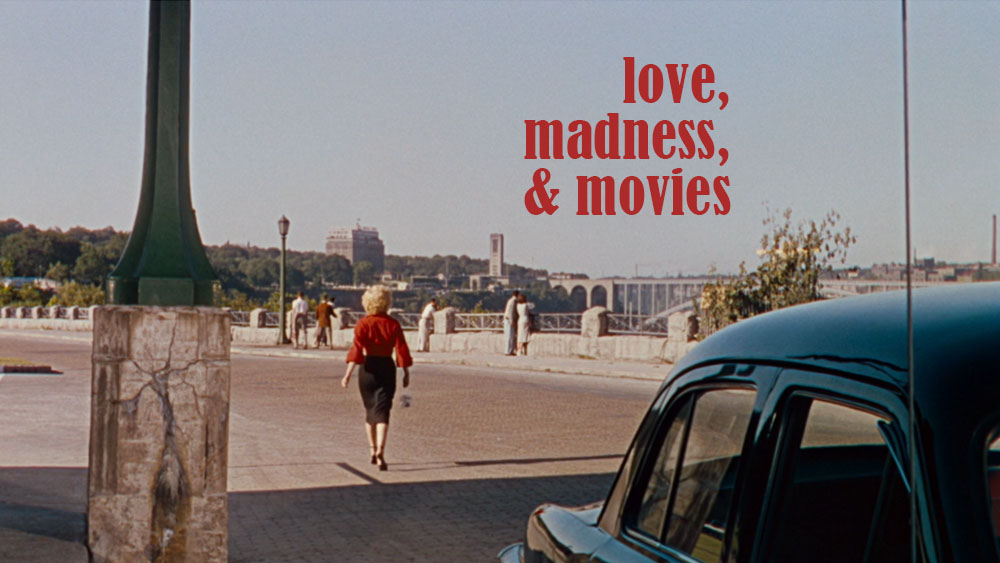
Niagara is a cozy 50s thriller starring Marilyn Monroe, Joseph Cotten, and Jean Peters. It’s one of the most Hitchcockian films I’ve seen; Vertigo would make the perfect double-feature thematically and visually. And speaking of visuals, it’s also beautiful; shot in color on location at Niagara Falls in Technicolor. Marilyn plays a surprising role surprisingly well. And the movie itself is a welcome surprise. I had a lot of fun with this one.
The film uses Niagara Falls exquisitely. It’s a gorgeous setting to photograph any story but that’s just the start. It’s also an idyllic location for a honeymoon so of course, a correspondingly wholesome couple appears. A couple whose love is the perfect contrast for that of Cotton and Monroe, whose relationship reflects another aspect of the falls, its danger. Their tragic entanglement sees him powerless to avoid a murderous and self-destructive fate. The falls works as a symbol of the runaway effect they have on each other, of being past the point of no return. But it also becomes the literal instrument of his doom.
Fail Safe
Fail Safe, directed by Sidney Lumet, and starring Henry Fonda, is a 1964 film evoking the existential nightmare that was the Cold War. It’s Dr. Strangelove, but played straight, and it’s basically perfect.
This is an amazing watch in the AI era; the central theme is the danger of letting machines operate without human oversight. Would that we could reseal nukes and AI alike in Pandora’s box.
Classic Hollywood
The Thin Man
The Thin Man is a delightful comedy whodunit starring William Powell and Myrna Loy, somehow balancing cute couple dynamics, a twisty murder mystery, and impossible levels of liquor consumption. I had a great time with this one, so I might check out the sequels.
Angels with Dirty Faces
Angels with Dirty Faces is a 1938 crime film directed by Michael Curtiz. Although otherwise sturdy, I think the central performance by James Cagney is the reason to see this.
Pat O’Brien’s performance is a little same-y throughout, but I still liked it; I believed his patience and pathos. But Ann Sheridan’s character is underwritten; we don’t really understand why she loves Rocky.
Am I old, or are the young hoodlums (the titular angels?) the worst part of this? They’re obnoxious and give every indication that they can’t be redeemed, so I grow tired of them quickly.
Also, I don’t think I’ve seen another movie with so much slapping.
Spiderverse
Spider-Man: Into the Spider-Verse
I rewatched Spider-Man: Into the Spider-Verse with my kids and it was a big hit. It had been a while since we had seen it. The writing is basically perfect, and the animation revolutionary. Add to that the great voice performances and needle drops and you have an all-timer.
Spider-Man: Across the Spider-Verse
Spider-Man: Across the Spider-Verse is a fantastic sequel, doubling down on the first film’s intricate writing and vivid animation. It weaves together an ambitious number of characters, plot points, and themes into an exciting and emotional extension of the first story. It’s a marvel. Impressive that it all works.
We eagerly await the next film.
There’s a point in the movie when it feels like it should end—something we feel in our bones because movies have trained us about how they work—but then there’s like 20 more minutes. By no means is this final sequence superfluous; it connects beautifully with what the first two movies have established. But I think its primary purpose is to connect with what lies ahead. I wonder how that connective tissue will feel once the third film is in place.
New releases
The Rivals of Amziah King
The Rivals of Amziah King is the followup film from director Andrew Patterson after his debut film, The Vast of Night. This one stars an overflowing-ly charismatic Matthew McConaughey as a beekeeper and spans genres from comedy to musical to thriller. My humblebrag is that I did the logo for G.E.D. Media which appears before the film.
The End of Oak Street
The End of Oak Street is a summer blockbuster-type movie, set in the 80s and in the tradition of Spielberg’s Jurassic Park and E.T. This is a fun watch with a bit of depth—a welcome synthesis.
Graphic violence isn’t something I usually revel in, but when this film went there, it was surprising in a good way. I found myself laughing, not because people being mauled and devoured by monsters is funny, but because the filmmakers went big. Those crazy bastards—they’re going for it!
There’s some interesting subtext about our human constructs, both mental and environmental. When your family is hunted by dinosaurs, you realize your suburban life is a privilege and a choice. And maybe your domestic problems are surmountable. I liked that this was not just another dumb dinosaur movie, but I think maybe the intellectual component isn’t fully realized.
Coyote vs. Acme
Coyote vs. Acme mixes animated characters with live action actors, similar to Roger Rabbit, although the technology has evolved significantly since 1988. With strong performances from Will Forte and Wile E. Coyote, it’s a decent family comedy that doesn’t quite get there for me.
Misc
Election
Election is a great comedy full of wonderful characters who are awful people. I’m glad I went back for this one, a true gap for me.
The Help
The Help is a 2011 drama based on the hit novel of the same name. This was a gap for me. I remember there being a big cultural moment around the book and film, and frankly, that’s the sort of thing I avoid. Give me fifteen years and I’m right on it.
Looking back from that kind of distance, it feels like a very Hollywood movie; a product, formulaic, and effective. I had a bit of a “they don’t make ‘em like this anymore” feeling, but of course, they do; commercial art is still what it is. What’s changed is that there’s more interest in authentic representation.
Great from a technical standpoint, with fantastic performances and support from a beautiful Thomas Newman score, I was rapt.
PlayTime
In PlayTime, the modern world (60s) seems to be the subject, with human beings sort of along for the ride, as tourists, or haplessly and absurdly herded about. It’s an unusual movie; I’ve never seen anything like it, although I gather it was true to form for director Jaques Tati. There’s not so much a story as there is a narrative. The film is composed of elaborate set pieces, crammed full of visual gags, auditory gags, and people.
As I watched it, I struggled to comprehend how it was achieved. Although it wasn’t my favorite thing ever, it’s easy to recommend as a novel experience.
Godzilla vs. Megalon
Godzilla vs. Megalon doesn’t have a lot going on other than people in monster suits punching each other, but I have to think if you were a kid in Japan in 1973, that was enough.
The Swimmer
The Swimmer is a 1968 drama starring Burt Lancaster. The film’s conceit becomes clear early enough that each curious episode that ensues begins to feel like it only makes the inevitable reveal more inevitable.